For years, Ericsson and Nokia have positioned massive MIMO as the defining technology of 5G: active antennas packed with electronics that form digital beams to track users with pinpoint precision. But a growing chorus of operators, analysts, and venue owners are asking a harder question: Does it actually deliver—and at what cost?
What Is Massive MIMO—and Why Is It Under Fire
Massive MIMO is expensive to buy, power-hungry to run, and its real-world performance has often fallen short of the marketing. In high-density venues like stadiums and arenas, where tens of thousands of users demand capacity simultaneously, a different approach is gaining traction: passive multibeam antennas that use physics—not power amplifiers—to divide a cell into multiple stable, independent beams.
Galtronics Multibeam: Lighter, Less Expensive, Proven in the Field
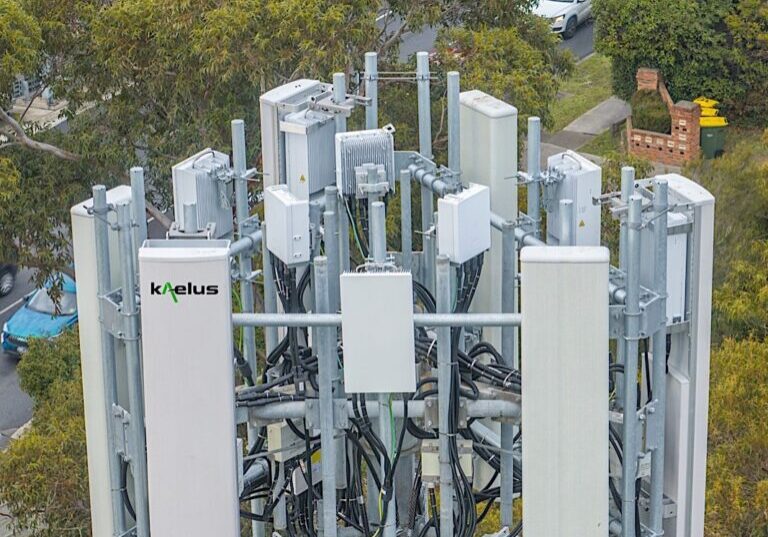
This is where Galtronics comes in. Galtronic’s panel-based multibeam antennas are designed specifically for the venues where massive MIMO struggles most. Lighter than legacy globe solutions, significantly more cost effective, and engineered with patented beam stabilization technology that keeps beams pointed where they should be across the entire operating band.
Read the full article linked below, which summarizes the key points from Light Reading’s analysis by Iain Morris of the multibeam vs. massive MIMO debate — and why Deutsche Telekom’s recent trial at a 250,000-person festival, where Galtronics multibeam antennas delivered a record 40 TB of data, signals where high-capacity 5G is heading.
Read the Full Feature:
Massive MIMO attacked as Galtronics bets on multibeam 5G growth
Galtronics lines up alongside Amphenol and MatSing to champion multibeam antennas over Ericsson’s and Nokia’s preferred 5G tech.
Iain Morris,International Editor,Light Reading
September 29, 2026
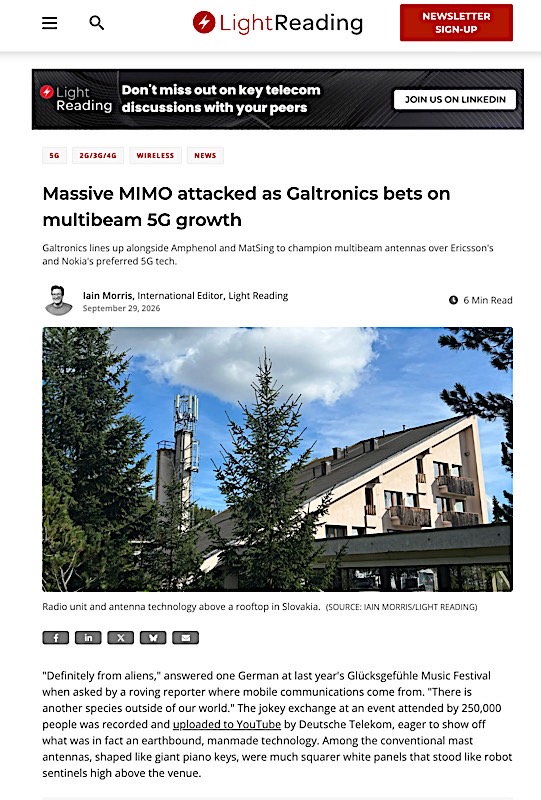
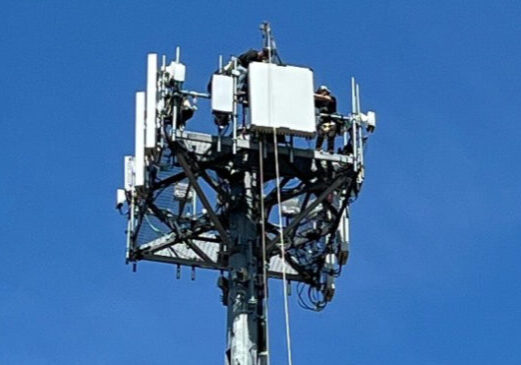
“Definitely from aliens,” answered one German at last year’s Glücksgefühle Music Festival when asked by a roving reporter where mobile communications come from. “There is another species outside of our world.” The jokey exchange at an event attended by 250,000 people was recorded and uploaded to YouTube by Deutsche Telekom, eager to show off what was in fact an earthbound, manmade technology. Among the conventional mast antennas, shaped like giant piano keys, were much squarer white panels that stood like robot sentinels high above the venue.
Most of Deutsche Telekom’s 4G and 5G infrastructure, including the antennas, comes from Huawei and Ericsson, the world’s two largest vendors of radio access network (RAN) products. Those square panels at Glücksgefühle were supplied by a less well-known Canadian company called Galtronics. State-of-the-art 5G technology relies heavily on electrical “active” antennas and massive MIMO, which crams dozens of transmitters and receivers into each unit. Galtronics is one of several developers of alternative “multibeam” antennas. Continues…